
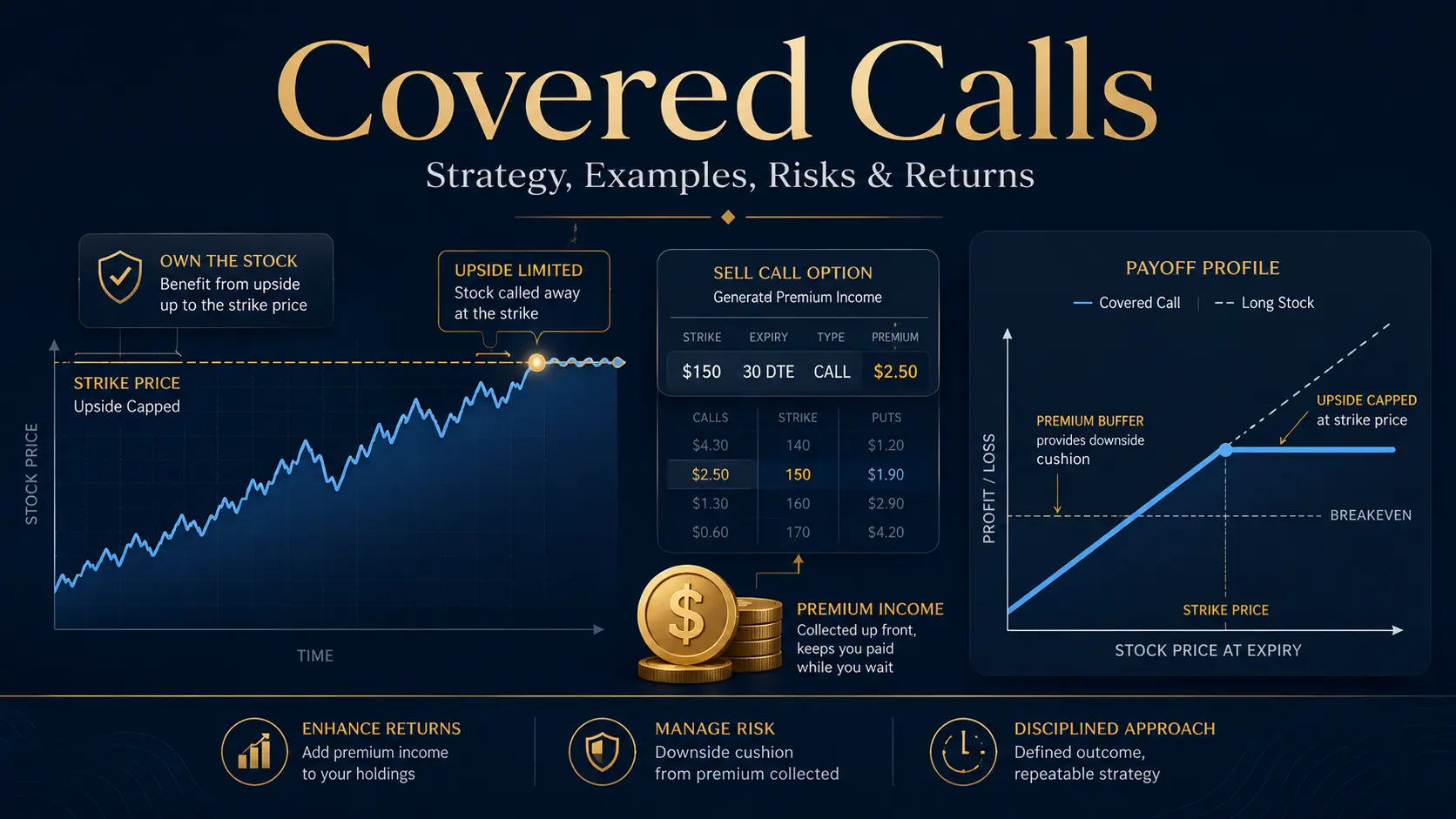
Covered calls are one of the most widely used options strategies for investors who want to generate additional income from stocks they already own.
The basic idea is simple: you own shares of a stock and sell a call option against those shares. In exchange, you receive an option premium.
But the strategy becomes considerably more interesting once you move beyond that definition.
A covered call changes the return profile of a stock position. It generates immediate income, gives up part of the potential upside, offers only limited downside protection, and introduces decisions about strike price, expiration, implied volatility, assignment risk and opportunity cost.
Used intelligently, covered calls can be a disciplined way to monetize volatility and generate income from an equity portfolio.
Used mechanically, they can simply exchange valuable upside for a premium that looked attractive at the time.
This guide explains both sides. For a regulatory primer on listed stock options, see Investor.gov’s Introduction to Options.
What Is a Covered Call?
A covered call, as defined by the Options Industry Council, combines two positions:
- A long position in a stock.
- A short call option on that same stock.
One standard equity option contract normally represents 100 shares, so an investor who owns 100 shares can sell one covered call.
Suppose you own:
- 100 shares of XYZ at $100
- You sell one $110 call expiring in 30 days
- You receive a $2.00 premium per share
The option premium produces:
$2 × 100 shares = $200
That $200 is yours immediately, regardless of what subsequently happens to the stock.
In exchange, however, you have given the buyer of the call the right to purchase your shares at $110 before or at expiration.
This creates the fundamental trade-off behind every covered call:
Income today in exchange for limiting some future upside.
[IMAGE: Basic covered-call structure showing long 100 shares + short 1 call]
How Covered Calls Work
At expiration, the outcome depends mainly on where the stock price is relative to the call’s strike price.
Using the previous example:
- Stock purchase price: $100
- Call strike: $110
- Premium received: $2
- Expiration: 30 days
There are three broad possibilities.
The Stock Remains Below the Strike
If XYZ finishes at $105, the $110 call expires worthless.
You keep:
- Your 100 shares
- The $200 option premium
- The $5 per-share unrealized gain on the stock
You can then decide whether to sell another covered call.
The Stock Finishes Above the Strike
Suppose XYZ rises to $115.
Your $110 call is in the money and the shares may be assigned.
You sell the shares for $110 each.
Your economic result is:
- $10 gain on the stock
- $2 premium received
- Total gain: $12 per share
Your effective sale price is therefore:
$112 per share
The problem is that the stock is now worth $115.
You have made money, but you surrendered the gain above your effective $112 exit price.
This is not technically a loss. It is an opportunity cost, and it is one of the most important risks in covered-call investing.
The Stock Falls
Suppose XYZ falls from $100 to $90.
The call expires worthless and you keep the $2 premium.
Your effective cost basis becomes approximately:
$100 − $2 = $98
But the stock is still worth only $90.
The premium reduced the loss. It did not eliminate it.
This is why a covered call should not be confused with a true downside hedge.
[TOOL / IMAGE: Covered Call Payoff Calculator]
Covered Call Example
Consider a more realistic decision.
An investor owns 100 shares of a company trading at $75.
The following 45-day calls are available:
| Strike | Premium | Approx. Delta |
|---|---|---|
| $75 | $4.80 | 0.52 |
| $80 | $2.60 | 0.33 |
| $85 | $1.20 | 0.18 |
Each strike produces a different trade-off.
Selling the $75 call generates the most income but gives the stock almost no room to appreciate.
Selling the $85 call produces much less income but preserves substantially more upside.
The $80 call sits somewhere between the two.
There is no universally correct choice.
The appropriate strike depends on what the investor is trying to accomplish.
That distinction matters because a covered call should not begin with:
Which option pays the highest premium?
It should begin with:
At what price would I genuinely be willing to sell this stock?
Once that question is answered, the option chain becomes much easier to evaluate.
[IMAGE: Option chain with strike, premium and delta highlighted]
Why Investors Sell Covered Calls
Covered calls are commonly used for several reasons.
Generate Income
The most obvious objective is collecting option premium.
An investor who already owns a stock can attempt to generate additional cash flow by repeatedly selling calls against the position.
Monetize High Implied Volatility
Option premiums tend to increase when implied volatility rises.
If the market is pricing unusually large future moves, call premiums may become more attractive.
That does not automatically mean a covered call is attractive, however. Elevated implied volatility often exists for a reason.
Earnings announcements, regulatory decisions, product launches and other major events can all increase option premiums.
Establish a Disciplined Exit Price
A covered call can also function as a conditional exit strategy for a stock position.
If you would willingly sell a stock at $120, selling a $120 call allows you to receive a premium while waiting.
If the stock reaches the strike and assignment occurs, the shares are sold at a price you had already accepted.
Reduce Cost Basis
Repeated option premiums can gradually reduce the economic cost of holding a stock.
This benefit is real, but it should not be exaggerated.
A $2 premium does not meaningfully protect an investor from a $30 decline.
When to Sell Covered Calls
One of the strongest covered-call questions is also one of the most misunderstood:
When is the best time to sell covered calls?
There is no single market condition that is always optimal, but covered calls tend to become more attractive when several factors align.
You Are Neutral to Moderately Bullish
Covered calls work naturally when you expect a stock to remain relatively stable or appreciate moderately.
If you expect a major rally, selling a call may be counterproductive because the strategy caps part of that upside.
You Would Be Comfortable Selling at the Strike
This is arguably the most important condition.
Do not sell a covered call at a strike where assignment would make you regret losing the stock.
A premium can look attractive until the underlying rallies 20%.
Implied Volatility Is Attractive
Higher implied volatility generally means higher option premiums.
But investors should distinguish between:
- high volatility that offers attractive compensation
- high volatility caused by an event whose risk they do not want to assume
This is where comparing implied volatility with historical volatility, IV percentile or IV rank can become useful.
[TOOL: Implied Volatility / Historical Volatility Comparison]
The Position Has Reached Part of Your Valuation Target
Covered calls can be particularly logical when a stock has appreciated toward your estimate of fair value.
Instead of immediately selling the shares, an investor may choose to sell an out-of-the-money call at a price where they would be comfortable exiting.
The Market Is Trading Sideways
A stock that remains below the strike allows the call seller to retain both the shares and the premium.
Repeatedly selling calls can therefore perform well in range-bound markets.
How to Choose a Covered Call Strike Price
Strike selection determines much of the strategy’s risk and return.
Three variables deserve particular attention:
- desired exit price
- delta
- premium received
Start With Your Desired Exit Price
The first question should be fundamental rather than mathematical.
At what price would you be willing to sell the stock?
If a company trades at $90 and your valuation suggests that $105 would be an attractive exit, strikes around $105 deserve attention.
This prevents the option premium from dictating the investment decision.
Use Delta as a Probability Proxy, Not a Promise
Option delta is often used as a rough indication of how likely an option is to expire in the money.
- 0.15 delta: relatively low probability of finishing ITM
- 0.30 delta: moderate probability
- 0.50 delta: approximately at-the-money exposure
Delta is not an exact probability of assignment, but it provides a useful framework.
A lower-delta covered call usually offers:
- less premium
- more upside room
- lower probability of assignment
A higher-delta covered call usually offers:
- more premium
- less upside room
- greater probability of assignment
[TOOL: Covered Call Strike Selector]
How to Choose the Expiration Date
Expiration is the second major decision.
Covered-call investors frequently use options ranging from a few weeks to several months.
Shorter expirations tend to offer:
- faster time decay
- greater flexibility
- more frequent management
Longer expirations tend to offer:
- larger absolute premiums
- slower time decay
- more time for the underlying stock to move significantly
A commonly examined area is approximately 20 to 60 days to expiration, although the appropriate choice depends on the stock, volatility environment and investor objective.
There is no magical DTE number.
A 30-day option with poor liquidity and unattractive volatility can be inferior to a 45-day option with a better risk/reward profile.
Covered Calls and Time Decay
Options lose time value as expiration approaches, all else being equal.
This process is represented by theta.
Because the covered-call investor is short the call, time decay generally works in the seller’s favor.
If the stock price, volatility and other factors remain relatively stable, the option can gradually lose value.
That may allow the investor to:
- let the call expire
- repurchase it at a lower price
- roll it into another expiration or strike
Time decay is therefore one of the structural reasons investors sell options rather than only buy them.
But theta should never be evaluated in isolation.
A sharp move in the underlying stock can overwhelm weeks of accumulated time decay in a matter of hours.
Implied Volatility and Covered Call Premiums
Implied volatility is one of the most important variables in option pricing. The Options Industry Council distinguishes it from historical volatility, which measures realized past price variation rather than the market’s forward-looking volatility estimate.
Higher implied volatility generally increases call premiums.
That makes high-volatility environments attractive to option sellers, at least superficially.
Suppose two otherwise similar stocks offer the following 30-day covered-call premiums:
- Stock A: 1.0%
- Stock B: 4.0%
Stock B appears far more attractive.
But the market may be pricing a much larger expected move in Stock B.
The correct question is not simply:
Which option has the highest premium?
It is:
Is the premium sufficient compensation for the risk I am taking?
This is where quantitative analysis becomes useful.
Relevant measures can include:
- implied volatility
- historical volatility
- IV rank
- IV percentile
- upcoming events
- option skew
- bid/ask spread
- open interest
- volume
[TOOL: Covered Call Quality Rating]
How to Calculate Covered Call Return
Covered-call returns can be measured in several ways.
Suppose:
- Stock price: $100
- Call premium: $2
- Strike: $105
- Days to expiration: 30
Premium Yield
The basic premium yield is:
Premium ÷ Stock Price
$2 ÷ $100 = 2%
Annualized Premium Yield
A simple annualized approximation is:
2% × 365 ÷ 30 = 24.3%
This number should be treated cautiously.
It assumes that similar trades can be repeated continuously under similar conditions, which is rarely true.
Maximum Return If Assigned
If the stock rises to or above $105:
- Stock gain: $5
- Premium: $2
- Total maximum gain: $7
Maximum return:
$7 ÷ $100 = 7%
over the 30-day period.
That figure provides a more complete picture than looking only at option premium.
[TOOL: Covered Call Return Calculator]
Covered Call Break-Even Price
The premium lowers the economic break-even point.
Using the same example:
- Purchase price: $100
- Premium received: $2
Break-even:
$100 − $2 = $98
If the stock finishes at $98, the investor has approximately broken even before taxes, commissions and other costs.
Below $98, the overall position loses money.
Covered Call Risk
Covered calls are often described as conservative. Investors using listed options should also understand the standardized risks described in the OCC’s Characteristics and Risks of Standardized Options.
That description can be misleading.
The option itself is covered by the underlying shares, so there is no unlimited short-call risk.
But the investor still owns the stock.
That means the largest source of risk is usually the equity position itself.
Downside Risk
If a stock falls sharply, the call premium provides only modest protection.
A stock falling from $100 to $60 remains a major loss even if the investor collected a $3 premium.
Upside Risk
The second major risk is opportunity cost.
If a stock rises dramatically above the strike, the call seller does not participate fully in that upside.
Assignment Risk
If the call is exercised, the shares can be sold at the strike price.
Assignment can occur before expiration, particularly when an option is deep in the money or around dividend dates.
Event Risk
Earnings announcements and other major corporate events can produce large stock moves.
The larger premium available before an event is not free income. It reflects greater expected uncertainty.
Covered Calls and Dividends
Dividend-paying stocks require additional attention.
Call holders may exercise options early when capturing the dividend becomes economically attractive.
Early assignment risk tends to become more relevant when:
- the call is in the money
- little extrinsic value remains
- the ex-dividend date is approaching
Investors who want to retain the stock through a dividend date should therefore monitor the option’s intrinsic and extrinsic value carefully.
What Happens When a Covered Call Is Assigned?
Assignment means the call seller must deliver the underlying shares at the strike price.
Suppose:
- You own 100 shares
- Strike price: $80
- Stock price at assignment: $86
Your shares are sold for:
100 × $80 = $8,000
You still retain the premium originally received.
Assignment is not inherently a bad outcome.
If $80 was an acceptable selling price when the trade was opened, the strategy has worked as designed.
Problems arise when investors choose strikes based solely on premium and later discover they never actually wanted to sell the stock.
Can You Close a Covered Call Before Expiration?
Yes.
A short call can usually be repurchased before expiration.
If you sold a call for $3 and later buy it back for $1:
- Premium received: $3
- Repurchase cost: $1
- Profit on option: $2
Investors may close covered calls early to:
- lock in most of the available premium
- avoid assignment
- respond to a change in the investment thesis
- roll the option
- manage an upcoming event
Rolling a Covered Call
Rolling means closing the existing call and simultaneously opening another call with a different strike, expiration or both.
Common variations include:
- Roll out: later expiration
- Roll up: higher strike
- Roll down: lower strike
- Roll up and out: higher strike and later expiration
Rolling is not a magical way to eliminate a losing trade.
Economically, it consists of closing one position and opening another.
Each decision should therefore be evaluated on its own merits.
When Not to Sell Covered Calls
Covered calls are not appropriate simply because a stock position exists.
You Expect Significant Upside
If your thesis depends on a major repricing of the stock, capping the upside may defeat the purpose of owning it.
The Premium Is Too Small
Low implied volatility can produce premiums that provide little compensation for giving up upside.
A Major Event Is Approaching
Earnings or other binary events can make assignment and price risk difficult to evaluate.
You Would Not Sell the Stock
If you would be unhappy to lose the shares at the strike, selling the call creates a conflict between your investment thesis and your option strategy.
The Options Are Illiquid
Wide bid/ask spreads and low volume can materially reduce the attractiveness of an otherwise sensible trade.
Covered Calls vs. Simply Holding the Stock
A covered call generally performs better than the stock alone when:
- the stock rises modestly
- the stock remains approximately flat
- the stock declines by less than the premium received
The stock alone generally performs better when:
- the stock rises substantially above the covered-call strike
Both positions suffer when the stock declines significantly, although the premium gives the covered call a small cushion.
For a market-level reference, Cboe publishes a family of BuyWrite benchmark indices, including the S&P 500 BuyWrite Index (BXM), designed to track hypothetical covered-call-style strategies on the S&P 500.
[IMAGE: Covered Call vs. Long Stock Payoff Comparison]
Covered Calls vs. Cash-Secured Puts
Covered calls and cash-secured puts can have surprisingly similar economic profiles when strikes and expirations are comparable.
A covered call consists of:
- long stock
- short call
A cash-secured put consists of:
- cash
- short put
Put-call relationships mean the two strategies can sometimes provide economically similar exposures.
The practical choice can depend on:
- whether you already own the shares
- whether you want to acquire them
- available option premiums
- account structure
- tax considerations
- capital allocation
[INTERNAL LINK: Cash-Secured Puts Guide]
A Better Covered Call Decision Process
Instead of beginning with the option chain, begin with the investment.
Step 1: Evaluate the Stock
Would you be comfortable owning the stock without selling calls?
If the answer is no, option premium does not repair the investment thesis.
Step 2: Define Your Exit Price
Determine a price at which selling the shares would be acceptable.
Step 3: Check Upcoming Events
Review:
- earnings
- dividends
- major company announcements
- regulatory events
Step 4: Evaluate Volatility
Compare implied volatility with the stock’s historical volatility and recent range.
Step 5: Select Expiration
Choose a timeframe consistent with your objective and willingness to manage the position.
Step 6: Compare Strikes
Evaluate:
- premium
- delta
- upside remaining
- probability of assignment
- total potential return
Step 7: Check Liquidity
Look at:
- bid/ask spread
- volume
- open interest
Step 8: Calculate the Complete Return
Do not evaluate the option premium alone.
Consider:
- premium yield
- maximum return if assigned
- break-even
- downside exposure
- opportunity cost
[TOOL: OptionsCrafted Covered Call Analyzer]
Covered Call Checklist
Before selling a covered call, ask:
- Would I own this stock without the option premium?
- Am I genuinely willing to sell at the strike?
- Is implied volatility attractive relative to the risk?
- Are earnings or other major events approaching?
- Is the option liquid?
- Does the premium adequately compensate me for limiting upside?
- What is my return if the stock remains flat?
- What is my return if assigned?
- What is my break-even price?
- What will I do if the stock moves sharply before expiration?
If those questions do not have clear answers, the trade probably needs more analysis.
Frequently Asked Questions About Covered Calls
What is a covered call?
A covered call is an options strategy in which an investor owns shares of a stock and sells call options against those shares. The option premium generates income, while the call limits some of the potential upside above the strike price.
How do covered calls make money?
Covered calls can make money through the premium received from selling the call and through appreciation of the underlying stock up to the strike price.
Can you lose money with covered calls?
Yes. The premium provides only limited downside protection. If the underlying stock falls substantially, the overall covered-call position can lose substantial value.
Are covered calls bullish or bearish?
Covered calls are generally considered neutral to moderately bullish. They tend to work best when the underlying stock remains relatively stable or rises moderately rather than making a very large upward move.
What is the best strike price for a covered call?
There is no universally best strike. The strike should reflect the price at which the investor would genuinely be willing to sell the stock, along with desired premium, delta, upside potential and assignment risk.
What delta is best for covered calls?
Many investors examine out-of-the-money calls with deltas roughly between 0.15 and 0.40, but there is no universally optimal delta. Lower delta generally preserves more upside and reduces assignment probability, while higher delta produces more premium.
What expiration is best for covered calls?
Covered-call sellers frequently examine expirations approximately 20 to 60 days away because they can provide a useful balance between premium, time decay and flexibility. The best expiration still depends on volatility, liquidity and the investor’s objectives.
When is the best time to sell covered calls?
Covered calls tend to be most attractive when implied volatility provides adequate premium, the investor is neutral to moderately bullish, and the strike represents a price where selling the stock would be acceptable.
Should you sell covered calls before earnings?
Selling calls before earnings can generate larger premiums because implied volatility is often elevated. However, the larger premium reflects greater event risk. Higher premium does not automatically mean better risk-adjusted value.
What happens if a covered call expires worthless?
If the stock finishes below the strike and the call expires worthless, the investor retains the shares and the entire option premium.
What happens if the stock goes above the covered call strike?
The option becomes in the money and the shares may be assigned at the strike price. The investor keeps the original premium but generally does not participate in stock gains above the effective sale price.
Can you buy back a covered call?
Yes. A short call can normally be repurchased before expiration. Investors may do this to take profits, avoid assignment, manage risk or roll the position.
Are covered calls good for generating income?
Covered calls can generate recurring option premium, but that income is compensation for giving up part of the stock’s upside and accepting continued downside exposure. The quality of the strategy therefore depends on the underlying stock, option pricing and strike selection, not simply on premium yield.
Final Thoughts
Covered calls are easy to understand mechanically and surprisingly difficult to use well.
Selling a call takes seconds and also sell cash covered puts is also a great strategy.
Deciding whether the premium fairly compensates you for the upside you surrender, the volatility you accept and the possibility of assignment requires considerably more thought.
The strongest covered-call process therefore begins with the underlying investment rather than the option premium.
Evaluate the stock.
Determine the price at which you would willingly sell it.
Examine volatility, events, liquidity, strike and expiration.
Then calculate the complete risk/reward profile.
A covered call should not turn a weak investment into an acceptable one. It should improve the economics of an investment you already understand.