
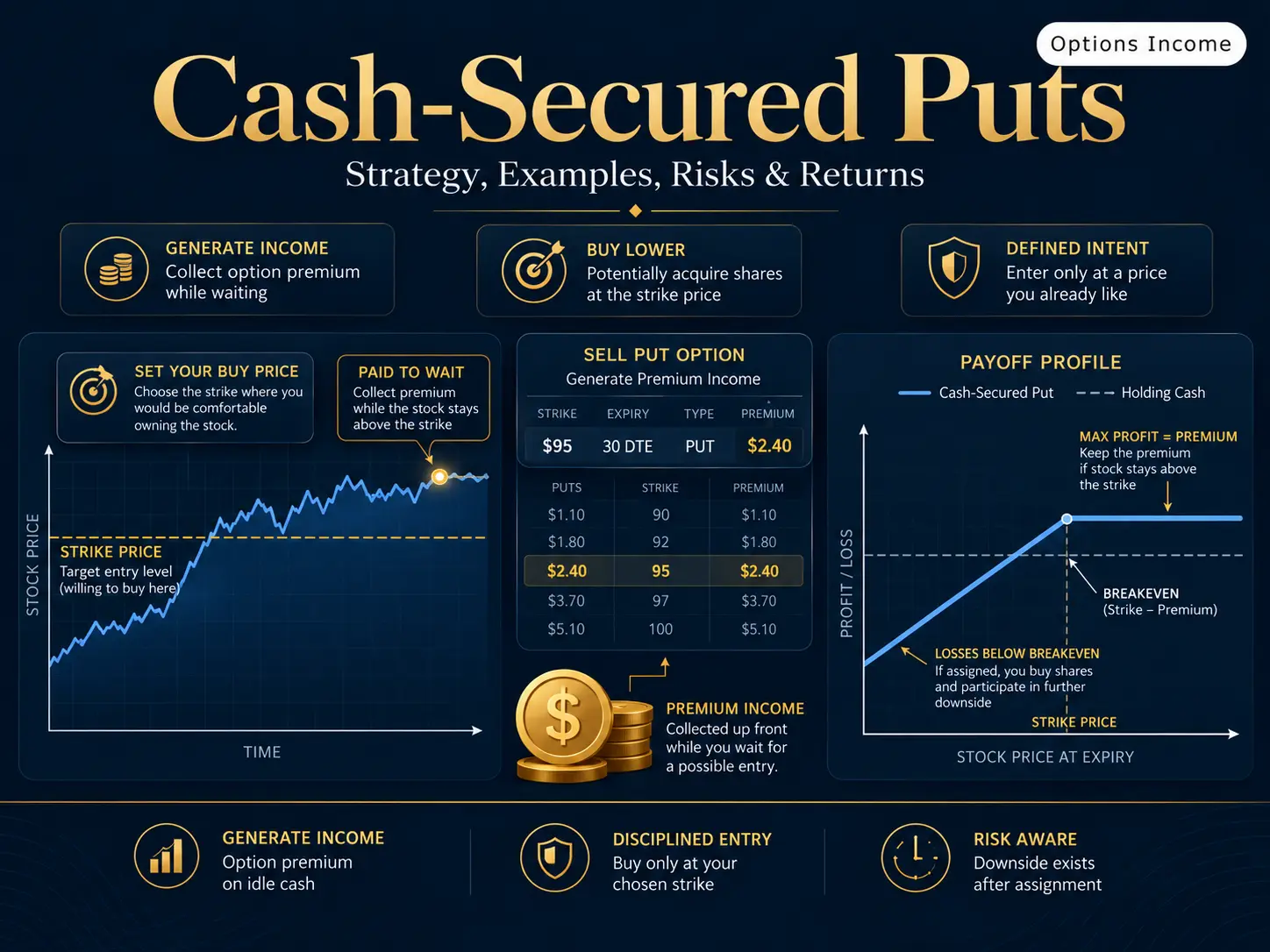
Cash-Secured puts are an options strategy that can serve two related purposes: generating option premium and potentially acquiring a stock at a price you already consider attractive.
A cash-secured put, sometimes informally called a cash-covered put, involves selling a put option while setting aside enough cash to purchase the underlying shares if assigned.
The mechanics are simple. You sell a put option and set aside enough cash to buy the underlying shares if you are assigned. In exchange for accepting that obligation, you receive an option premium.
But the strategy is not simply a way to “get paid to wait.” A cash-secured put exchanges immediate premium income for a real commitment: if the stock falls, you may be required to buy 100 shares per contract at the strike price even when the market price is substantially lower.
That makes the quality of the underlying stock, valuation, strike selection, expiration, implied volatility and position sizing more important than the premium alone.
Used intelligently, a cash-secured put can combine disciplined stock acquisition with option income. Used mechanically, it can become an efficient way to collect a small premium before buying a falling stock at too high a price.
This guide explains both sides.
Table of Contents
Cash-Secured Put Key Takeaways
- A cash-secured put combines a short put with enough reserved cash to meet the stock-purchase obligation if assigned.
- The maximum option profit is the premium received.
- The effective purchase price if assigned is approximately strike price minus premium received.
- The main risk is not the option itself. It is being required to buy a stock that has fallen substantially below the strike.
- The first question should be “Would I genuinely want to own this stock at this price?”, not “Which put pays the highest premium?”
What Is a Cash-Secured Put?
A cash-secured put is created by selling a put option while reserving enough cash to buy the underlying shares if the option is assigned.
The Options Industry Council describes the cash-secured put primarily as a stock-acquisition strategy for an investor who is willing to buy the underlying stock at a predetermined price.
One standard U.S. equity option contract generally represents 100 shares. If you sell one put with a $90 strike, you must therefore be prepared to purchase 100 shares for $90 each if assigned.
The gross stock-purchase obligation is:
$90 × 100 shares = $9,000
If you receive a $2.50 premium per share, the option premium is:
$2.50 × 100 shares = $250
If assigned, your effective economic purchase price becomes approximately:
$90 − $2.50 = $87.50 per share
The premium improves the economics of the purchase. It does not guarantee that $87.50 will be a good price when assignment occurs.
[IMAGE: Cash-secured put structure — short 1 put + cash reserved for 100 shares]
How Cash-Secured Puts Work
Suppose XYZ trades at $100 and you would be comfortable buying it at a lower valuation.
- Current stock price: $100
- Put strike: $90
- Premium received: $2.50 per share
- Expiration: 35 days
- Gross cash needed for assignment: $9,000
At expiration, three broad outcomes matter.
The Stock Remains Above the Strike
If XYZ finishes at $96, the $90 put expires out of the money and, assuming it is not exercised, you keep the $250 premium.
You do not acquire the stock.
You can then decide whether to buy the shares outright, sell another put, or deploy the cash elsewhere.
The Stock Finishes Below the Strike
Suppose XYZ finishes at $86.
The $90 put is in the money and you may be assigned 100 shares at $90.
Because you already collected $2.50 per share in premium, your effective economic cost is approximately $87.50 per share before commissions, taxes and other costs.
But the stock is now trading at $86.
You acquired the stock below its original $100 market price, but not below its current market price. That distinction is fundamental.
The Stock Falls Sharply
Suppose an unexpected event sends XYZ to $60.
You may still be obligated to buy the shares at $90. The $2.50 premium lowers your effective cost to $87.50, but it provides only limited protection against a $40 decline in the stock.
This is the central risk of cash-secured puts: the downside can resemble owning the stock, while the maximum option profit is limited to the premium received.
[IMAGE / TOOL: Cash-Secured Put Payoff Diagram]
Cash-Secured Put Example
Now consider a strike-selection decision rather than a single option.
A stock trades at $100 and the investor would be comfortable owning it, but only at a sufficiently attractive valuation.
| Strike | Premium | Put Delta | Effective Purchase Price |
|---|---|---|---|
| $95 | $3.80 | -0.38 | $91.20 |
| $90 | $2.10 | -0.24 | $87.90 |
| $85 | $1.00 | -0.13 | $84.00 |
The $95 put generates the most premium but commits the investor to buying at the highest strike.
The $85 put generates much less premium but creates a substantially lower effective acquisition price and a lower probability of finishing in the money.
The $90 strike sits between those outcomes.
There is no universally correct strike. The correct decision depends on valuation, desired entry price, volatility, probability of assignment and the investor’s willingness to own the shares.
A cash-secured put should therefore not begin with:
Which put has the highest annualized return?
It should begin with:
At what price would I genuinely want to own this business?
Only after that question is answered should the option chain determine whether the available premium adequately compensates you for making that commitment.
[IMAGE: Option chain showing strike, premium, delta and effective purchase price]
Why Investors Sell Cash-Secured Puts
Acquire a Stock at a Target Price
The strongest use case is straightforward: you already want to own a stock, but you believe the current market price is above your preferred entry point.
Selling a put at or near that target price allows you to receive premium while accepting the possibility of assignment.
Generate Premium While Waiting
If the stock remains above the strike and the put expires worthless, the seller retains the premium without purchasing the shares.
That premium is compensation for accepting downside exposure and tying capital to the potential purchase obligation. It is not free income.
Create a Disciplined Entry Process
A cash-secured put can force an investor to define the price at which a stock becomes attractive before market volatility changes the emotional decision.
This works particularly well when the strike is supported by fundamental valuation rather than selected solely because its premium looks appealing.
Monetize Elevated Implied Volatility
Higher implied volatility generally increases option premiums, all else being equal. That can improve the compensation received for selling a put, but elevated volatility usually reflects greater expected uncertainty.
The premium is larger because the risk is larger or is perceived to be larger.
A Cash-Secured Put Does Not Guarantee a “Discount”
Cash-secured puts are often described as a way to “buy stocks at a discount.” That description needs qualification.
If a stock trades at $100 and you sell a $90 put for $2, assignment gives you an effective purchase price near $88.
That is below the original $100 price.
But if the stock has fallen to $70 by the time you are assigned, paying an effective $88 is not a discount to the market. It is an immediate unrealized loss.
The strategy therefore offers a predefined acquisition price, not a guaranteed bargain.
This is why fundamental stock selection and valuation belong at the center of the process.
How to Choose a Cash-Secured Put Strike Price
Strike selection determines the balance between premium income, acquisition price and assignment probability.
Start With Valuation, Not Premium
Estimate the price at which the stock would offer an acceptable expected return and margin of safety.
If your analysis suggests that a stock trading at $110 becomes attractive around $95, strikes near $95 deserve attention. A $105 put paying a larger premium should not automatically override that valuation work.
Consider the Effective Purchase Price
The strike is not the whole story.
The approximate effective purchase price if assigned is:
Strike Price − Premium Received
Compare that effective price with your estimate of fair value, expected return and downside scenarios.
Use Delta as a Risk Indicator, Not a Promise
Put options normally display negative delta. Investors often refer to the absolute value when comparing strikes, so a put quoted at -0.25 may be described informally as a “25-delta put.”
Lower absolute delta generally means a farther out-of-the-money strike, lower premium and lower probability of finishing in the money. Higher absolute delta generally means more premium and a greater chance of assignment.
Delta is useful, but it is not an exact probability of assignment. The Fidelity / Cboe cash-secured short-put guide also illustrates how short-put delta changes with moneyness and how time and volatility affect the position.
[TOOL: Cash-Secured Put Strike Selector]
How to Choose an Expiration for Cash-Secured Puts
There is no universally best DTE for cash-secured puts.
Shorter expirations provide faster turnover and greater flexibility, but they require more frequent decisions and can expose the position to sharper short-term gamma risk near expiration.
Longer expirations usually provide larger absolute premiums and more time for the stock thesis to play out, but they also lock up capital for longer and may respond more strongly to changes in implied volatility.
A practical comparison should consider:
- premium received
- annualized premium yield
- theta decay
- gamma near expiration
- capital lock-up
- earnings and other events
- liquidity and bid/ask spread
The correct expiration is the one that produces an acceptable complete risk/reward profile, not the one that creates the most impressive annualized percentage.
Cash-Secured Puts and Time Decay
A short put generally benefits from the passage of time if the stock price, implied volatility and other variables remain unchanged.
This is the effect of theta.
As expiration approaches, the time-value component of an out-of-the-money put tends toward zero.
But theta is not a guarantee of profit. A sufficiently large decline in the underlying stock or increase in implied volatility can overwhelm accumulated time decay quickly.
Implied Volatility and Cash-Secured Put Premiums
Higher implied volatility generally increases option premiums, which can make short puts appear more attractive.
But the correct question is not:
Which stock has the highest put premium?
It is:
Is the premium sufficient compensation for the downside risk and the possibility of owning this stock at the strike?
Useful inputs can include:
- implied volatility
- historical volatility
- IV rank or IV percentile
- earnings and event risk
- put skew
- bid/ask spread
- open interest and volume
- fundamental valuation
[TOOL: Cash-Secured Put Quality Rating]
Should You Sell Cash-Secured Puts Before Earnings?
Earnings can produce unusually high option premiums because implied volatility often rises before the announcement.
That premium is not a gift. It reflects the market’s expectation of greater uncertainty and a potentially larger stock-price move.
If a disappointing earnings report pushes a stock well below the strike, a cash-secured put seller may be assigned at a price far above the new market value.
Selling puts before earnings can therefore be reasonable only when the investor understands the event risk and remains comfortable owning the stock even after a materially negative surprise.
How to Calculate Cash-Secured Put Return
Suppose:
- Stock price: $100
- Put strike: $90
- Premium: $2.00 per share
- Days to expiration: 30
Premium Received
$2.00 × 100 = $200
Gross Cash Secured
$90 × 100 = $9,000
Brokerage treatment of collateral and premium can vary, so always check the actual buying-power requirement in your account.
Premium Yield on Gross Secured Cash
$200 ÷ $9,000 = 2.22%
Simple Annualized Premium Yield
2.22% × 365 ÷ 30 ≈ 27.0%
This annualized number should be treated cautiously. It assumes that similar trades can be repeated throughout the year under comparable conditions and does not capture changing volatility, assignment, transaction costs, taxes, idle periods or losses.
Effective Purchase Price If Assigned
$90 − $2 = $88 per share
[TOOL: Cash-Secured Put Return Calculator — premium yield, annualized yield, breakeven, effective purchase price, downside cushion]
Cash-Secured Put Break-Even Price
At expiration, the approximate break-even price for a cash-secured put is:
Strike Price − Premium Received
Using the previous example:
$90 − $2 = $88
If the stock finishes at $88 at expiration, the position is approximately at economic break-even before commissions, taxes and other costs.
Below $88, the position has an economic loss.
Cash-Secured Put Risks
Cash-secured does not mean risk-free.
The cash solves the funding problem if assignment occurs. It does not solve the investment risk.
Downside Stock Risk
The largest risk is a major decline in the underlying stock.
If a $90 strike put is sold for $2 and the stock falls to zero, the theoretical maximum loss at expiration is approximately:
($90 − $2) × 100 = $8,800
The premium is small relative to the potential loss from owning a collapsing stock.
Opportunity Cost
If the stock rallies strongly while your put remains out of the money, you keep the premium but may miss substantial upside that would have been captured by buying the shares outright.
Assignment Risk
Assignment can occur before expiration for American-style equity options. You should therefore be prepared to purchase the shares whenever the short put remains open.
Liquidity Risk
Wide bid/ask spreads, limited open interest or poor trading volume can make it expensive to adjust or close a position.
Event Risk
Earnings, regulatory decisions, litigation, acquisitions and other company-specific events can move the stock far more than the premium initially received.
For a formal overview of exchange-traded option risks, investors should review the Options Clearing Corporation’s Characteristics and Risks of Standardized Options.
What Happens When a Cash-Secured Put Is Assigned?
Assignment means the put seller is required to purchase the underlying shares at the strike price.
If you sold one $90 put, assignment normally creates a long position of 100 shares purchased for $90 each.
You still retain the option premium, so the economic cost basis is reduced by the premium received.
Assignment should not automatically be viewed as a failed trade. If you sold the put because $90 represented an attractive acquisition price, assignment is one of the outcomes the strategy was designed to accept.
The trade has failed conceptually when assignment reveals that you never actually wanted to own the stock at that price.
Can a Cash-Secured Put Be Assigned Early?
Yes. American-style equity options can generally be exercised before expiration, so a short put can be assigned early.
The Fidelity / Cboe strategy guide specifically identifies early assignment as a real risk and notes that the result is simply an earlier purchase of the underlying shares.
If your investment thesis depends on avoiding ownership until expiration, the strategy is therefore poorly matched to that objective.
Can You Close a Cash-Secured Put Before Expiration?
Yes. A short put can normally be repurchased before expiration.
Suppose you sell a put for $3.00 and later buy it back for $1.00.
- Premium received: $3.00
- Repurchase cost: $1.00
- Option profit before costs: $2.00 per share
Investors may close a put early to lock in gains, free capital, avoid an unwanted event, reduce risk or change the original investment thesis.
Rolling a Cash-Secured Put
Rolling means closing the existing short put and opening another put with a different strike, expiration or both.
- Roll out: move to a later expiration.
- Roll down: move to a lower strike.
- Roll down and out: move to both a lower strike and later expiration.
Rolling does not erase a loss. Economically, it closes one position and opens another.
The new put should therefore make sense as a fresh trade based on the current stock price, valuation, volatility and risk, rather than being used merely to avoid acknowledging that the original thesis changed.
Cash-Secured Put vs. Buying the Stock
Buying the stock immediately and selling a cash-secured put are different decisions.
Buying stock gives immediate ownership and full participation in future upside and downside.
Selling a cash-secured put provides premium income and may create a lower effective entry price, but the investor may never acquire the stock if it continues to rise.
| Decision | Buy Stock Now | Sell Cash-Secured Put |
|---|---|---|
| Own shares immediately | Yes | No |
| Participate fully in strong rally | Yes | No |
| Receive option premium | No | Yes |
| Possible lower effective entry | No | Yes, if assigned |
| Risk if stock collapses | Substantial | Substantial |
If you believe the stock is materially undervalued today and expect a large upward move, buying the shares may be more consistent with the thesis.
If you would prefer ownership only at a lower valuation and are willing to miss a rally, a cash-secured put may be more suitable.
Cash-Secured Put vs. Limit Order
A cash-secured put is sometimes compared with placing a limit order to buy a stock below the current market price.
The comparison is useful, but the two are not identical.
| Feature | Buy Limit Order | Cash-Secured Put |
|---|---|---|
| Target purchase price | Yes | Yes, via strike |
| Premium received | No | Yes |
| Time expiration | Depends on order | Yes |
| Possible early assignment | No | Yes |
| Obligation once option sold | No option obligation | Yes |
| Can miss a rising stock | Yes | Yes |
The premium is the major advantage of the put. The contractual obligation and option-specific risks are the price paid for receiving it.
Cash-Secured Put vs. Naked Put
Both positions involve selling a put, but the capital structure and investment intent differ.
A cash-secured put reserves sufficient cash to meet the potential stock-purchase obligation. A naked or uncovered put relies on margin or other available capital rather than fully reserving the purchase amount.
The economic downside of the short put remains substantial in either case. Cash securing the position addresses funding and leverage; it does not make the underlying stock risk disappear.
Cash-Secured Put vs. Covered Call
Cash-secured puts and covered calls are closely related options-income strategies.
A cash-secured put begins with cash and a willingness to buy shares. A covered call begins with shares already owned and a willingness to sell them at a strike price.
| Feature | Cash-Secured Put | Covered Call |
|---|---|---|
| Starting asset | Cash | 100 shares |
| Option sold | Put | Call |
| Primary decision | At what price will I buy? | At what price will I sell? |
| Premium income | Yes | Yes |
| Major risk | Stock falls after/into assignment | Owned stock falls |
| Strong rally opportunity cost | May never acquire shares | Upside capped above strike |
Under simplified assumptions, positions using the same strike and expiration can have very similar expiration payoff profiles because of put-call parity. In real portfolios, dividends, interest on collateral, taxes, transaction costs, early exercise and starting ownership can make the practical experience different.
The Options Industry Council also identifies the covered call as the comparable position for a cash-secured put.
Cash-Secured Put Writing as a Benchmark Strategy
Cash-secured put writing is not limited to individual retail trades.
Cboe maintains several institutional PutWrite benchmark indices, including the Cboe S&P 500 PutWrite Index (PUT), which represents a rules-based strategy combining short index puts with cash or Treasury-bill collateral.
These benchmarks are useful because they separate the strategy from anecdotes about individual trades and provide a framework for evaluating option-writing behavior across different market environments.
They should not be interpreted as evidence that every cash-secured put trade will outperform simply because a benchmark has particular historical characteristics.
Does the Cash Collateral Earn Interest?
Potentially, but this depends on the broker, account type and the form of collateral permitted.
This matters because a cash-secured put ties up substantial capital. If eligible collateral earns interest, the total economic return may include both option premium and collateral yield.
Cboe’s PUT benchmark, for example, uses Treasury-bill collateral rather than assuming that secured cash earns nothing.
Do not assume your brokerage account behaves the same way. Check how reserved cash affects buying power, settlement and interest before including collateral yield in expected returns.
Cash-Secured Puts and the Wheel Strategy
The Wheel Strategy combines cash-secured puts and covered calls into a recurring process.
- Sell a cash-secured put on a stock you are willing to own.
- If the put expires worthless, consider selling another put.
- If assigned, take ownership of the shares.
- Sell covered calls against the shares.
- If the shares are called away, return to cash and potentially restart the cycle.
The Options Industry Council describes the Wheel as a two-stage premium-income cycle built from these two strategies.
The Wheel does not eliminate the underlying equity risk. If the assigned stock experiences a permanent or prolonged decline, repeated option premiums may be small relative to the capital loss.
[INTERNAL LINK FUTURE: Complete Wheel Strategy Guide]
When Not to Sell Cash-Secured Puts
You Do Not Actually Want the Stock
If assignment would cause immediate regret, the trade is poorly designed regardless of the premium.
The Stock Is Fundamentally Weak or Difficult to Value
A large option premium cannot repair a weak investment thesis. High implied volatility often exists precisely because uncertainty is high.
You Expect a Major Rally
If the investment case depends on substantial near-term upside, waiting for assignment may create significant opportunity cost.
The Option Is Illiquid
Wide spreads and poor liquidity can make entry and exit unnecessarily expensive.
The Position Is Too Large for the Portfolio
One option contract usually represents 100 shares. A seemingly modest trade can therefore create a large concentrated equity position after assignment.
You Are Selling Only Because the Annualized Yield Looks High
Very high annualized yields often reflect short holding periods, elevated volatility, event risk or downside exposure that the percentage alone does not communicate.
A Better Cash-Secured Put Decision Process
Instead of opening the option chain and searching for premium, begin with the underlying business.
Step 1: Decide Whether You Want to Own the Stock
If the answer is no, stop. The option premium does not change the investment thesis.
Step 2: Estimate Fair Value and Your Desired Entry Price
Define the price at which expected return and downside risk become acceptable.
Step 3: Check Upcoming Events
- earnings
- dividends
- regulatory decisions
- product or clinical events
- mergers or corporate actions
Step 4: Evaluate Implied Volatility
Determine whether the premium appears attractive relative to historical volatility, event risk and the downside you are accepting.
Step 5: Select an Expiration
Balance premium, time decay, capital lock-up, event exposure and management frequency.
Step 6: Compare Strikes
- strike price
- premium
- effective purchase price
- delta
- distance from fair value
- assignment probability proxy
Step 7: Check Liquidity
- bid/ask spread
- volume
- open interest
Step 8: Calculate the Complete Return and Risk
- premium yield
- annualized premium yield
- effective purchase price
- break-even
- maximum theoretical loss
- opportunity cost if the stock rallies
- portfolio concentration if assigned
[TOOL: OptionsCrafted Cash-Secured Put Analyzer]
Cash-Secured Put Checklist
Before selling a cash-secured put, ask:
- Would I buy this stock without the option premium?
- What is my estimate of fair value?
- Would I genuinely buy 100 shares at the strike?
- What is my effective purchase price after premium?
- How large would the position become if assigned?
- Are earnings or other major events approaching?
- Is implied volatility adequately compensating me for the risk?
- Is the option liquid?
- What is my break-even price?
- What happens to my portfolio if the stock falls 20%, 30% or 50%?
- Am I comfortable missing the stock if it rallies?
- What will I do if the investment thesis changes before expiration?
If those questions do not have clear answers, the trade probably needs more analysis.
Frequently Asked Questions About Cash-Secured Puts
What is a cash-secured put?
A cash-secured put is an options strategy in which an investor sells a put and reserves enough cash to buy the underlying shares if assigned. The seller receives an option premium in exchange for accepting the obligation to purchase the shares at the strike price.
How do cash-secured puts make money?
The maximum option profit is the premium received when the put is sold. If the option expires worthless, the seller keeps that premium. If assigned, the premium reduces the effective economic purchase price of the shares.
Can you lose money with cash-secured puts?
Yes. If the stock falls substantially below the strike, the investor may be required to buy shares at a price well above the current market value. The premium provides only limited downside protection.
How much cash do you need for a cash-secured put?
You generally need enough available capital to meet the full stock-purchase obligation if assigned. For one standard contract with a $50 strike, the gross obligation is typically 100 shares × $50, or $5,000. Actual brokerage collateral and buying-power treatment can vary.
What is the best strike price for a cash-secured put?
There is no universally best strike. A strong process begins with the price at which you genuinely want to own the stock, then evaluates premium, effective purchase price, delta, volatility and assignment risk around that valuation.
What delta is best for cash-secured puts?
No single delta is optimal for every investor. Lower absolute delta generally provides less premium and lower assignment likelihood, while higher absolute delta produces more premium and greater exposure to the underlying stock. Delta should support the desired acquisition price rather than replace valuation analysis.
What expiration is best for cash-secured puts?
There is no universal best DTE. Shorter expirations offer faster turnover and greater management frequency, while longer expirations usually provide more absolute premium and longer capital commitment. The choice should reflect volatility, liquidity, events and the investor’s objectives.
What happens if a cash-secured put expires worthless?
If the put expires out of the money and is not exercised, the seller keeps the premium and the reserved cash is no longer required for that option obligation. The investor does not acquire the stock through the put.
What happens if a cash-secured put is assigned?
Assignment requires the put seller to buy the underlying shares at the strike price. One standard equity option contract usually results in the purchase of 100 shares. The premium received reduces the effective economic purchase price.
Can a cash-secured put be assigned before expiration?
Yes. American-style equity options can generally be exercised before expiration, so a short put can be assigned early. A cash-secured put seller should be financially and psychologically prepared to own the shares while the position remains open.
Are cash-secured puts safer than buying stock?
Not inherently. The premium and lower effective purchase price provide a limited cushion, but a cash-secured put still has substantial downside exposure if the stock collapses. The strategy also introduces assignment, liquidity and option-management considerations.
Is a cash-secured put better than a limit order?
Neither is universally better. A cash-secured put pays premium for accepting a contractual purchase obligation, while a limit order does not generate option premium and has no option-assignment risk. The better choice depends on whether the premium adequately compensates you for the additional obligations and risks.
Cash-secured put or covered call: which is better?
The better choice usually depends on the starting position. If you hold cash and want to acquire shares at a target price, a cash-secured put may fit naturally. If you already own shares and are willing to sell them at a target price, a covered call may fit better.
Should you sell cash-secured puts before earnings?
Earnings can increase implied volatility and option premiums, but the higher premium reflects greater event risk. Selling a put before earnings makes sense only if you remain comfortable owning the stock at the strike after a materially negative earnings surprise.
Are cash-secured puts part of the Wheel Strategy?
Yes. The Wheel typically begins by selling cash-secured puts. If assigned, the investor owns the shares and can then sell covered calls. If those shares are later called away, the process can return to selling puts.
Final Thoughts
Cash-secured puts are mechanically simple and strategically demanding.
Selling a put takes seconds.
Determining whether the premium fairly compensates you for the downside exposure, whether the strike represents an attractive valuation, and whether assignment would improve rather than damage your portfolio requires considerably more thought.
The strongest cash-secured put process therefore begins with the business, not the option chain.
Evaluate the stock.
Estimate fair value.
Define the price at which you would genuinely want to own it.
Then evaluate strike, expiration, implied volatility, liquidity, assignment risk and total portfolio exposure.
A cash-secured put should not persuade you to buy a stock you did not already want. It should improve the economics and discipline of an investment decision you were prepared to make anyway.