

Asset allocation is the process of deciding how much of a portfolio should be invested across different asset classes such as stocks, bonds, cash, and real assets. It is one of the most important decisions an investor makes because it determines where portfolio risk comes from before any individual security is selected.
A well-designed portfolio is not simply a collection of good investments. It is a structure in which different assets perform different jobs: generating growth, preserving capital, providing income, maintaining liquidity, or reducing exposure to specific economic risks.
This guide explains how asset allocation works, why diversification depends on economic exposures rather than the number of holdings, and how investors can build portfolios around their objectives, risk tolerance, time horizon, and changing market environments.
Table of Contents
Asset Allocation: The Short Answer
Asset allocation means dividing a portfolio among different asset classes rather than allowing one type of investment to determine the entire outcome.
A practical asset allocation process can be reduced to a few steps:
- Define the objective of the portfolio.
- Determine the investment time horizon.
- Assess both risk tolerance and financial capacity for risk.
- Choose the appropriate mix of equities, bonds, cash, and other assets.
- Diversify both across and within asset classes.
- Evaluate how different holdings interact with each other.
- Rebalance when portfolio weights drift materially from their intended targets.
- Adjust the allocation when financial objectives change, not simply because markets become noisy.
The objective is not to create a portfolio that performs best in every market environment. No portfolio can do that consistently. The objective is to build a portfolio capable of meeting its long-term purpose while keeping risk within acceptable limits.
1. What Asset Allocation Really Means
Asset allocation is often presented as a simple percentage exercise: 60% stocks, 30% bonds, 10% cash, for example.
But the percentages are only the visible result of a deeper decision.
The real purpose of asset allocation is to decide which economic risks the investor wants to own, in what proportions, and for what reason.
Stocks generally provide exposure to corporate earnings and economic growth. Bonds provide contractual cash flows and can help stabilize a portfolio. Cash provides liquidity and optionality. Real assets may provide exposure to inflation, scarcity, property, infrastructure, or commodities.
The U.S. Securities and Exchange Commission’s Investor.gov resource on asset allocation and diversification defines asset allocation as dividing investments among categories such as stocks, bonds, and cash, with the appropriate mix depending primarily on time horizon and risk tolerance.
That is why there is no universally correct asset allocation. The portfolio has to solve a specific investor’s problem.
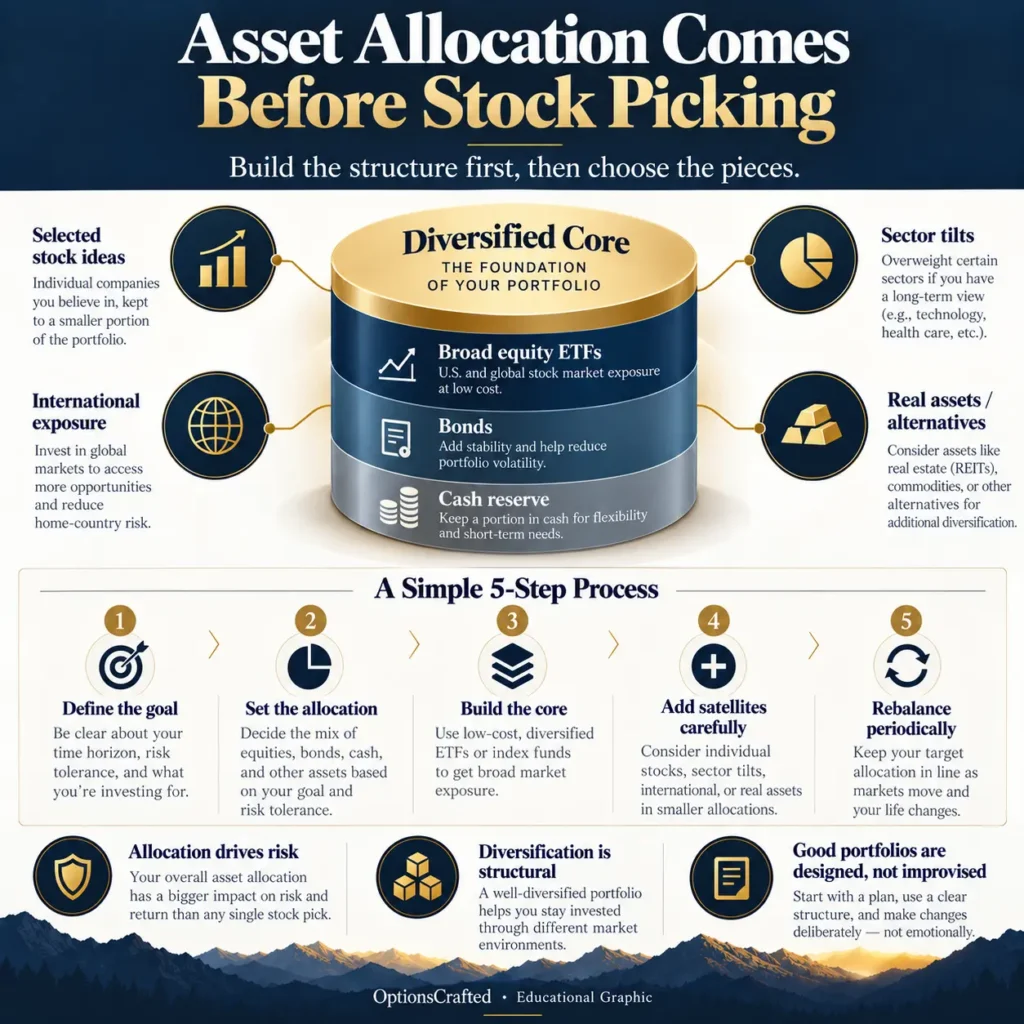
2. Why Asset Allocation Comes Before Stock Picking
Investors naturally spend a great deal of time deciding which company, ETF, or fund to buy.
But security selection occurs inside a portfolio structure that already determines much of the investor’s exposure to risk.
Consider an investor who owns ten excellent technology companies. Those businesses may be individually strong, but the portfolio can still be heavily exposed to the same factors: equity valuations, interest rates, technology spending, growth expectations, and investor sentiment.
Adding more securities does not necessarily solve that problem.
A better sequence is:
Objective → Asset Allocation → Diversification → Security Selection → Position Sizing
This forces individual investment ideas to serve the portfolio rather than allowing the portfolio to become the accidental result of a collection of unrelated ideas.
3. The Main Asset Classes
A portfolio can contain thousands of financial products, but most of them ultimately derive their behavior from a smaller set of underlying asset classes.
Equities
Equities represent ownership in businesses.
Their long-term return potential comes primarily from earnings growth, dividends, share repurchases, and changes in valuation.
Stocks can generate substantial long-term growth, but they can also experience large drawdowns and extended periods of weak returns.
Bonds
Bonds represent contractual claims on governments, companies, or other borrowers.
Their risk and return depend on factors including interest rates, duration, inflation, credit quality, and the probability that promised payments will be made.
Bonds can provide income and, depending on their structure, help reduce overall portfolio volatility.
Cash and Cash Equivalents
Cash provides liquidity and capital stability, although its purchasing power can decline over time when inflation exceeds the return earned on cash holdings.
Cash also provides optionality. Investors with available liquidity do not need to sell long-term assets simply because an expense arises or because an attractive opportunity appears.
Real Assets
Real estate, infrastructure, commodities, and precious metals have economic characteristics that differ from traditional stocks and bonds.
Depending on the asset, they may provide exposure to inflation, physical scarcity, rental income, commodity cycles, or other return drivers.
Alternative Assets
Private equity, private credit, hedge-fund strategies, digital assets, and other alternatives can introduce additional sources of return and diversification.
They can also introduce higher fees, illiquidity, leverage, operational complexity, valuation uncertainty, or technological risk. Their inclusion should therefore have a specific portfolio purpose.
4. Risk, Return, and Correlation
Asset allocation is not simply about selecting assets with attractive expected returns. It is also about understanding how those assets behave together.
Three concepts are particularly important:
- Return: the gain or loss generated by an investment.
- Risk: the possibility that actual outcomes differ materially from what the investor needs or expects.
- Correlation: the degree to which different assets tend to move together.
If two assets respond to the same economic forces in nearly the same way, owning both may provide less diversification than their different names suggest.
Conversely, combining assets with different economic sensitivities can reduce dependence on any one market environment.
Correlation is not permanent. Assets that behave differently under normal conditions can become more correlated during periods of market stress. Diversification therefore reduces certain risks but does not eliminate portfolio losses.
5. Strategic vs Tactical Asset Allocation
Not every allocation decision needs to operate on the same time scale.
Strategic Asset Allocation
Strategic asset allocation establishes the long-term structure of the portfolio.
It answers questions such as how much equity risk the investor should normally hold, how much liquidity is required, and what role bonds or other diversifiers should play.
The strategic allocation should normally change relatively slowly because it reflects long-term objectives rather than short-term market forecasts.
Tactical Asset Allocation
Tactical allocation involves temporary deviations from the strategic allocation when valuations, market conditions, liquidity, or macroeconomic circumstances create an unusually attractive or unattractive opportunity.
For example, an investor might temporarily maintain more cash when valuations are unusually demanding or modestly increase exposure to an asset class following a significant repricing.
The danger is allowing every opinion about the economy to become an excuse to rebuild the portfolio.
A useful rule is that tactical decisions should modify a sound strategic structure rather than replace it.
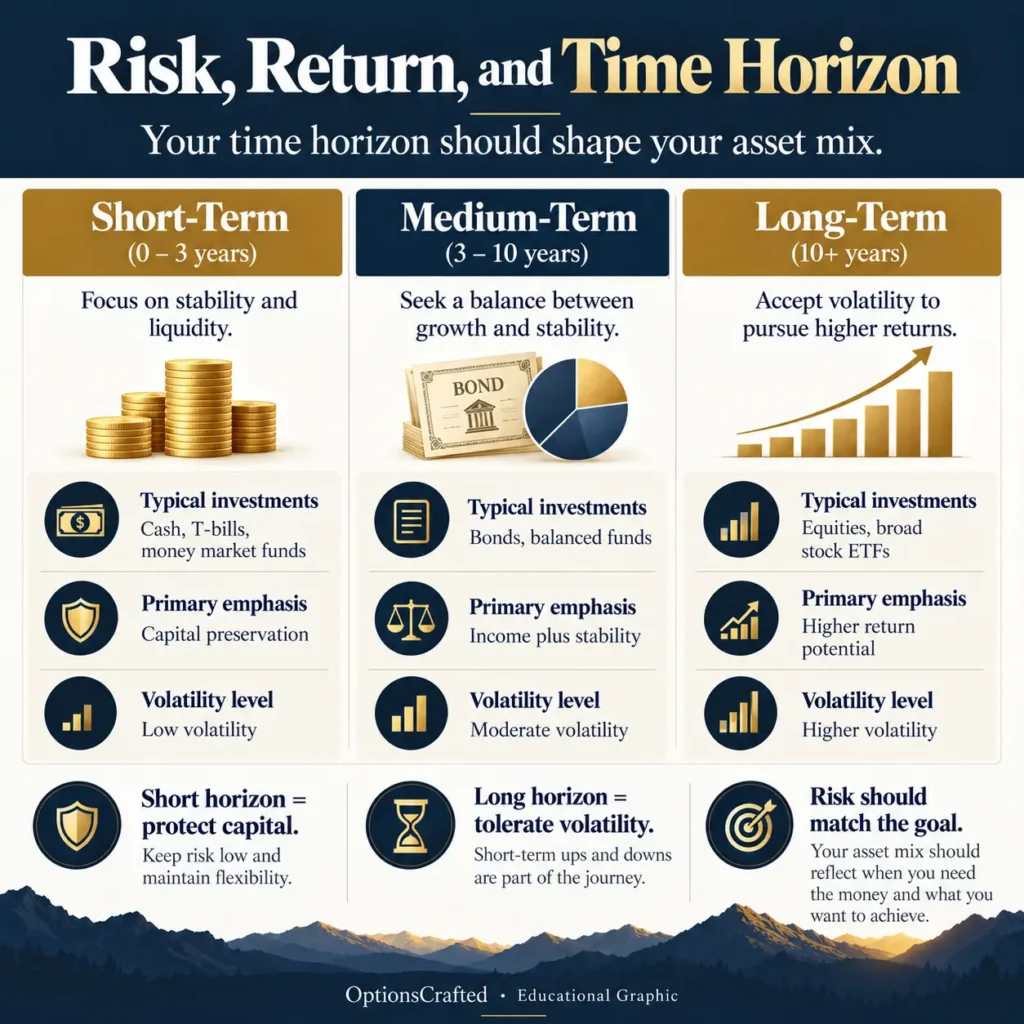
6. How Time Horizon Changes Asset Allocation
The appropriate asset allocation depends heavily on when the investor expects to need the money.
A long investment horizon provides more time to recover from temporary market declines. A short horizon reduces that flexibility.
Short-Term Goals
Capital required within the next few years generally has a greater need for liquidity and stability.
Money for a home purchase, tuition payment, tax obligation, or other known near-term expense should not depend excessively on the behavior of volatile assets at the exact moment the money is needed.
Long-Term Goals
Longer horizons can justify accepting greater short-term volatility when doing so increases long-term return potential.
This does not mean that every long-term investor should own the maximum possible amount of equities. Risk capacity, income stability, liquidity requirements, and behavioral tolerance still matter.
For investors still establishing these foundations, our guide on how to start investing explains the relationship between financial objectives, time horizon, valuation, risk, and portfolio construction.
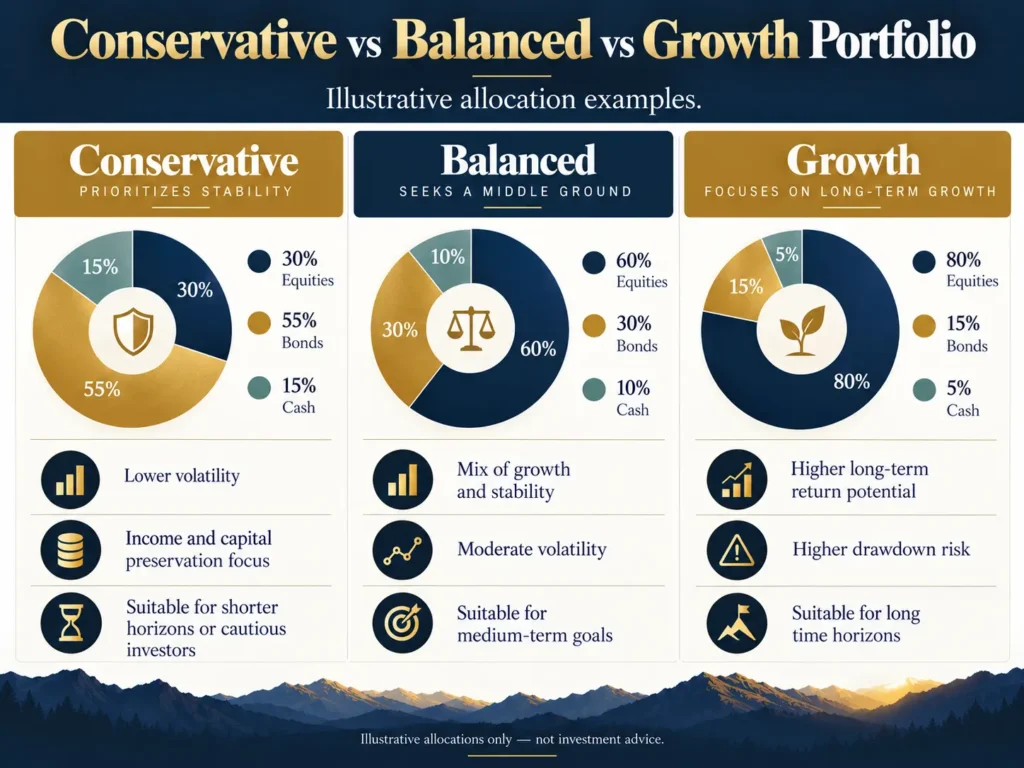
7. Conservative, Balanced, and Growth Portfolios
Portfolio labels such as conservative, balanced, and growth are useful shorthand, but they should not be mistaken for universal formulas.
The following allocations are purely illustrative examples of how risk exposure can change as portfolio objectives change.
Illustrative Conservative Allocation
- 30% equities
- 50% bonds
- 20% cash and short-term instruments
The emphasis is capital stability, liquidity, and income, with enough equity exposure to retain some long-term growth potential.
Illustrative Balanced Allocation
- 60% equities
- 30% bonds
- 10% cash and short-term instruments
The portfolio accepts meaningful equity volatility while retaining defensive assets that can provide liquidity and reduce dependence on stock-market performance.
Illustrative Growth Allocation
- 80% equities
- 15% bonds
- 5% cash and short-term instruments
The emphasis is long-term capital appreciation, with a greater willingness to tolerate significant interim drawdowns.
These examples are educational rather than recommendations. Two investors of the same age can rationally hold very different allocations because their financial circumstances, objectives, income stability, and risk tolerance differ.
8. Diversification Across Economic Risks
True diversification is not measured by the number of positions in a brokerage account.
It is measured by how many genuinely different sources of economic risk and return the portfolio contains.
A useful way to think about diversification is to ask how different assets might respond to changes in:
- economic growth;
- inflation;
- interest rates;
- credit conditions;
- liquidity;
- currency movements;
- commodity prices;
- and investor risk appetite.
A portfolio dominated by assets that all require strong economic growth and falling interest rates may appear diversified by ticker symbol while remaining highly concentrated economically.
FINRA’s educational guide to asset allocation and diversification similarly distinguishes between allocation across asset classes, diversification within those asset classes, and periodic rebalancing.
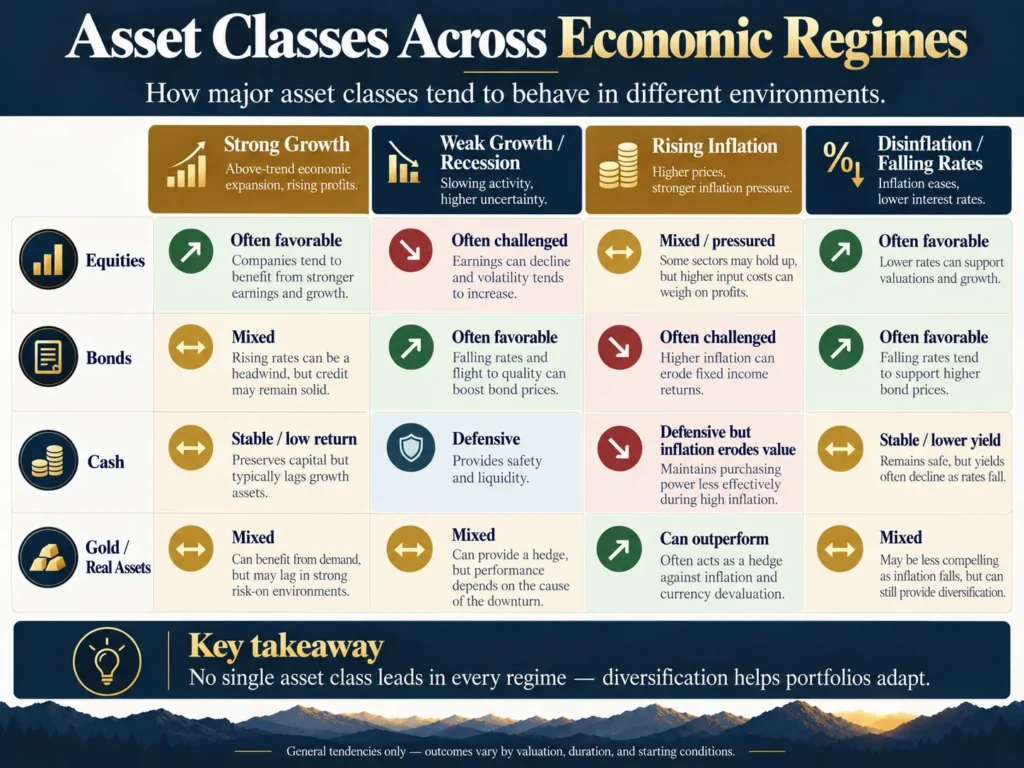
9. Asset Classes Across Different Market Environments
Different assets tend to respond differently to changes in growth, inflation, interest rates, and liquidity.
This is one reason portfolios should not be constructed around a single economic forecast.
Broadly speaking:
- Equities often benefit from sustained economic growth and rising corporate profits.
- High-quality bonds can become more attractive when growth weakens or interest rates decline.
- Cash becomes more competitive when short-term interest rates are high.
- Inflation-sensitive real assets may perform differently when inflation pressures rise.
- Credit-sensitive assets can struggle when financing conditions deteriorate.
These relationships are tendencies, not laws. Markets price expectations in advance, and the same asset can behave differently depending on valuation and the source of an economic shock.
That is precisely why allocation should be built around resilience rather than confidence in one forecast.
10. International Diversification
Investors often develop a strong home-country bias, holding a disproportionate amount of the companies and assets located in the country where they live.
This is understandable. Domestic companies are familiar, financial information is easier to access, and local markets may feel safer.
But geographic concentration exposes a portfolio to one country’s economic cycle, currency, political framework, sector composition, and valuation environment.
International diversification can broaden exposure to different industries, currencies, valuations, and sources of economic growth.
It also introduces additional risks, including currency movements, political uncertainty, different accounting regimes, and potentially higher investment costs.
The relevant question is therefore not whether international assets are always better or worse than domestic assets. It is whether geographic diversification improves the resilience and opportunity set of the overall portfolio.
11. ETFs and the Portfolio Core
Broad ETFs can make asset allocation considerably easier because a single fund can provide exposure to hundreds or thousands of securities within an asset class.
This makes ETFs particularly useful for building a diversified portfolio core.
However, owning multiple ETFs does not automatically create diversification.
Two funds may contain many of the same companies, sectors, or economic exposures. Narrow thematic ETFs can also create substantial concentration despite containing dozens of individual securities.
The investor should therefore examine what an ETF actually owns rather than assuming diversification from the fund label alone.
We examine this decision in more detail in ETFs vs Individual Stocks: How to Build the Core of Your Portfolio.
12. The Role of Cash in Asset Allocation
Cash is often treated as a temporary holding rather than a legitimate part of portfolio allocation.
That view is too simplistic.
Cash can provide:
- emergency liquidity;
- capital for planned expenses;
- protection from forced selling;
- dry powder for future opportunities;
- lower portfolio volatility;
- and collateral for strategies such as cash-secured puts.
The cost of cash is opportunity cost. Capital held in cash may compound more slowly than productive assets over long periods and may lose purchasing power to inflation.
Cash therefore needs a job just like every other component of the portfolio.
13. Rebalancing the Portfolio
Even a carefully designed asset allocation will not remain unchanged.
Assets appreciate and decline at different rates. As a result, the portfolio gradually drifts away from its original target.
If a portfolio begins with 60% equities and equities substantially outperform bonds, the equity allocation may eventually become 70% or 75% without the investor making a single new decision.
The portfolio is now taking more equity risk than originally intended.
Rebalancing means bringing portfolio weights back toward their strategic targets.
Investor.gov describes rebalancing as restoring a portfolio toward its original asset allocation after different investments have grown at different rates.
Common approaches include:
- rebalancing at fixed intervals;
- rebalancing when allocations move outside predetermined tolerance bands;
- using new contributions to purchase underweight assets;
- or combining these approaches.
The purpose is not to predict which asset will perform best next. It is to prevent market movements from silently redesigning the portfolio.
14. Common Asset Allocation Mistakes
Building the Portfolio One Investment at a Time
Buying attractive investments independently can produce a portfolio with unintended concentrations and duplicated exposures.
Confusing More Holdings With More Diversification
Twenty holdings exposed to the same underlying risk can still behave like one large concentrated position.
Ignoring Correlation
The interaction between holdings matters as much as their individual characteristics.
Using Historical Returns as a Forecast
An asset class that performed exceptionally well in the recent past may begin the next period with higher valuations and lower prospective returns.
Overreacting to Macro Forecasts
Economic analysis can improve portfolio decisions, but constantly rebuilding a long-term allocation around every forecast usually creates more activity than insight.
Never Rebalancing
Without rebalancing, the assets that have recently performed best gradually become the largest positions, potentially increasing risk precisely because prices have already risen.
15. How Options Fit Into Portfolio Allocation
Options are not an asset class in the same sense as equities, bonds, or cash.
They are contracts that can modify the payoff profile of assets already present in the portfolio.
Used appropriately, options can influence:
- income generation;
- entry prices;
- downside exposure;
- upside participation;
- portfolio volatility;
- and the use of cash reserves.
A covered call, for example, changes the return profile of an existing equity position. A cash-secured put can define a potential acquisition price while using cash as collateral. Protective options can transfer specific downside risks in exchange for a premium.
The important principle is that the option strategy should serve the portfolio allocation rather than dictate it.
16. The OptionsCrafted Asset Allocation Framework
At OptionsCrafted, we view portfolio allocation as a sequence of decisions rather than a static percentage formula.
1. Define the Objective
Determine what the portfolio must accomplish and when the capital may be needed.
2. Establish the Strategic Core
Create diversified exposure to the asset classes required to meet the long-term objective.
3. Measure Economic Exposure
Look beyond ticker symbols and identify the growth, inflation, interest-rate, liquidity, credit, currency, and valuation risks embedded in the portfolio.
4. Evaluate Valuation
Strategic exposure may be long term, but the expected return from an asset still depends partly on the price paid.
5. Add Tactical Exposure Selectively
Individual stocks, sectors, macro themes, options, or alternative assets should be added only when they improve the expected portfolio outcome relative to the additional risk introduced.
6. Rebalance and Review
Allow the strategic framework to remain stable while adapting deliberately when objectives, valuations, or underlying financial circumstances materially change.
In compact form:
Goal → Core Allocation → Diversification → Valuation → Tactical Exposure → Rebalancing
17. Asset Allocation Checklist
Before finalizing a portfolio allocation, ask:
- What financial objective is this portfolio designed to achieve?
- When might the capital be required?
- How much temporary drawdown can I tolerate?
- How much permanent loss can I financially absorb?
- Which asset classes provide the portfolio’s growth?
- Which assets provide liquidity or stability?
- Am I diversified across genuinely different economic risks?
- Do multiple funds contain the same underlying exposures?
- What assumptions are embedded in current valuations?
- How and when will the portfolio be rebalanced?
- What would justify changing the strategic allocation?
If the answers are unclear, the portfolio structure probably needs more work before additional securities are added.
Frequently Asked Questions About Asset Allocation
What is asset allocation?
Asset allocation is the process of dividing a portfolio among different asset classes such as equities, bonds, cash, and other investments. The appropriate mix depends on objectives, time horizon, liquidity requirements, and risk tolerance.
Why is asset allocation important?
Asset allocation determines how much of the portfolio is exposed to different sources of risk and return. A portfolio can contain excellent individual investments and still be poorly constructed if those investments are concentrated in the same economic risks.
What is the difference between asset allocation and diversification?
Asset allocation determines how capital is divided among asset classes. Diversification spreads exposure both across and within those asset classes so that the portfolio is less dependent on any single investment or economic outcome.
What is a good asset allocation?
There is no universally correct allocation. A suitable portfolio is one that provides a realistic probability of meeting the investor’s objective while keeping liquidity needs, volatility, and potential losses within acceptable limits.
How often should a portfolio be rebalanced?
Some investors rebalance periodically, while others rebalance when asset weights move beyond predefined tolerance ranges. The important principle is to use a consistent rule rather than react emotionally to short-term market movements.
Does diversification prevent losses?
No. Diversification can reduce dependence on individual investments or specific risks, but it cannot eliminate market losses. During periods of broad financial stress, correlations between different assets can also increase.
Can asset allocation change over time?
Yes. Allocation may need to change as the investor approaches a financial goal, requires more income or liquidity, experiences a change in financial circumstances, or develops a different capacity for risk.
Final Thoughts
Good portfolio construction begins before the first stock, ETF, or bond is selected.
Asset allocation defines the structure within which every individual investment has to operate. It determines where risk is concentrated, where liquidity comes from, how much volatility the portfolio can absorb, and which economic environments matter most to the investor’s outcome.
The objective is not to predict exactly which asset class will outperform next. It is to create a portfolio capable of surviving the fact that no investor knows that consistently in advance.
Build the structure first. Diversify the underlying risks. Pay attention to valuation. Add active ideas deliberately. Rebalance when necessary.
Individual investments may change repeatedly over an investor’s lifetime. A sound asset allocation framework can remain useful through all of them.