
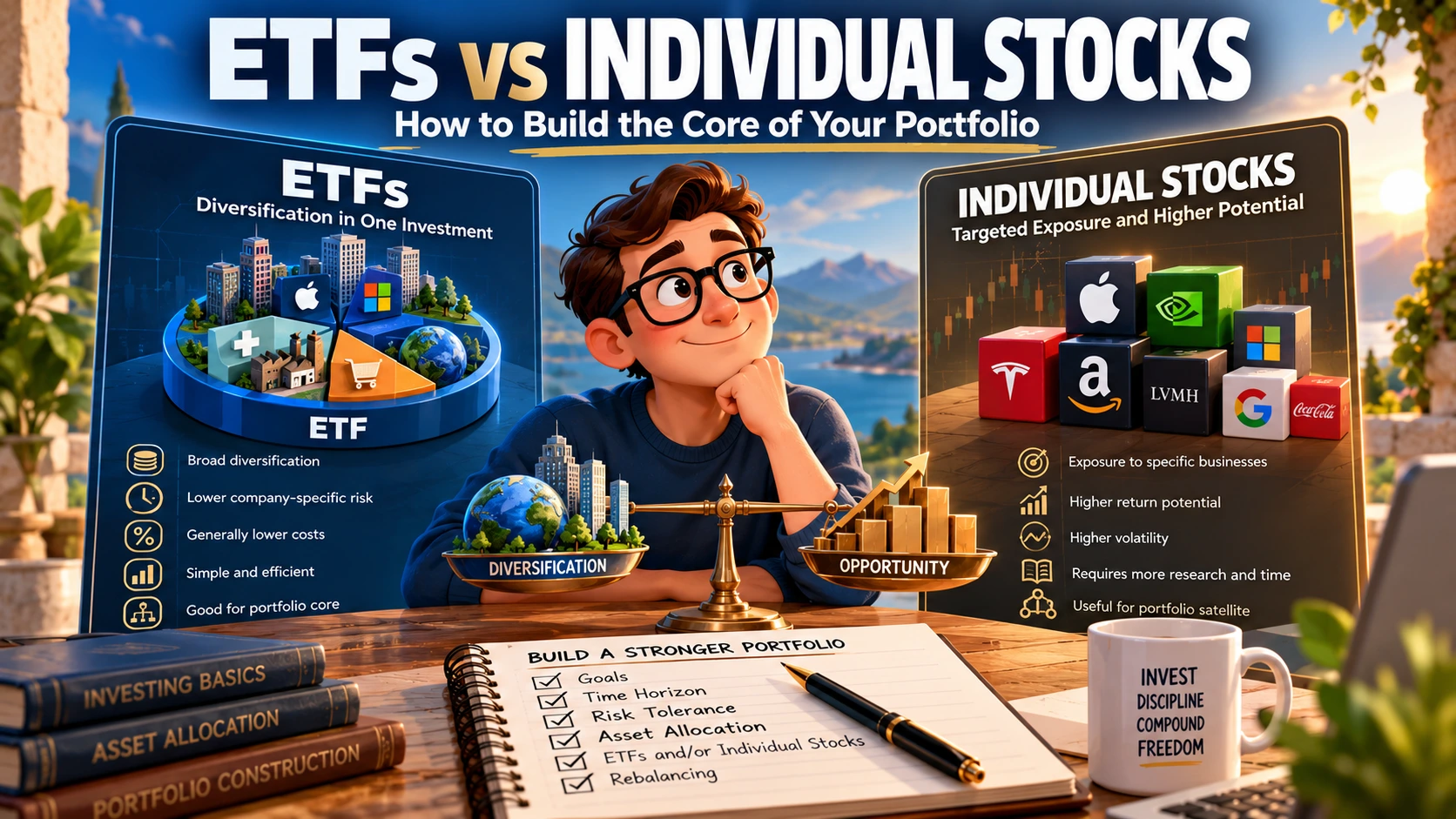
Choosing between ETFs vs individual stocks is not simply a question of which can produce higher returns. The more useful question is which approach best fits your portfolio structure, available time, ability to analyze businesses, diversification needs, and tolerance for company-specific risk.
For many investors, broad exchange-traded funds provide an efficient way to build the core of a portfolio. Individual stocks can then be added selectively when the investor has a clear thesis, sufficient knowledge, and a reason to accept more concentrated risk.
This guide compares ETFs and individual stocks across diversification, costs, valuation, research requirements, risk, return potential, and portfolio construction. It also explains how both can work together through a core-satellite approach.
Table of Contents
ETFs vs Individual Stocks: The Short Answer
ETFs and individual stocks solve different portfolio problems.
- ETFs are generally better suited to broad diversification, efficient market exposure, lower research requirements, and building a portfolio core.
- Individual stocks provide greater control over company quality, valuation, sector exposure, dividend characteristics, and position sizing.
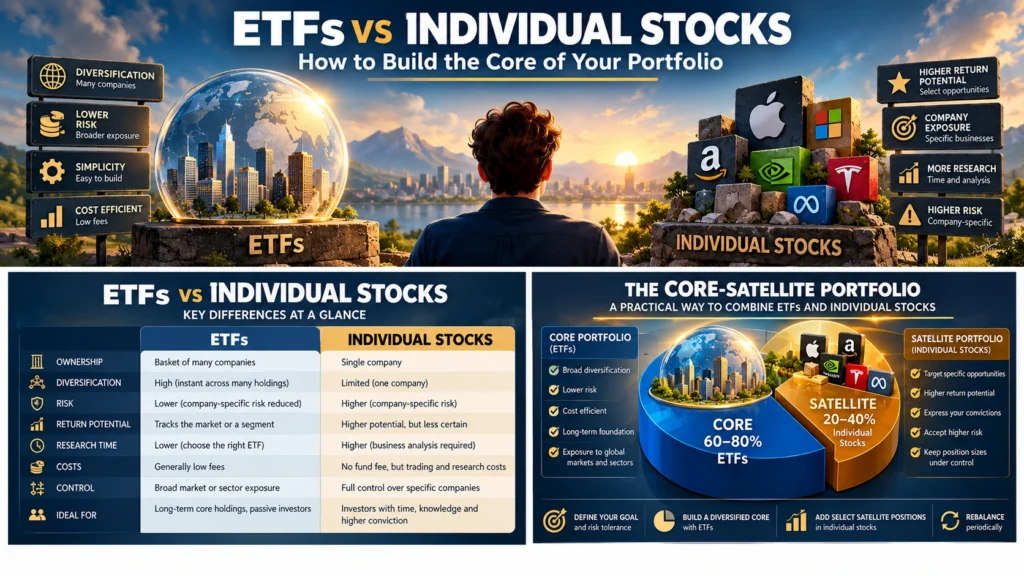
- A combined approach can use diversified ETFs as the core and selected stocks as satellite positions where the investor has sufficient conviction.
The correct choice is therefore not necessarily ETFs or individual stocks. For many portfolios, the better question is how much of each should be used and what role each position is expected to perform.
1. What Is an ETF?
An exchange-traded fund, or ETF, pools capital from many investors and invests that capital in a portfolio of securities or other assets according to a defined objective.
An ETF can provide exposure to a broad stock market index, a specific sector, bonds, international markets, commodities, factors, or a particular investment strategy.
The SEC’s Investor.gov guide to exchange-traded funds explains that ETF shares represent an investor’s ownership interest in the fund’s underlying portfolio and can be traded on an exchange during market hours.
The important point is that an ETF is a wrapper. What matters economically is what the fund actually owns, how concentrated it is, what index or strategy it follows, and how much it costs.
2. What Does It Mean to Own an Individual Stock?
Owning an individual stock means owning an equity interest in a specific company.
The investor participates directly in that company’s future earnings, dividends, capital allocation, competitive position, and valuation changes.
This creates more control than an ETF, but also more responsibility.
An individual company can outperform dramatically, but it can also experience permanent impairment because of poor management, excessive debt, technological disruption, fraud, regulation, competition, or simply paying too high a price for the business.
3. Diversification: The Main Advantage of ETFs
One of the strongest arguments for broad ETFs is diversification.
A single broad-market ETF can provide exposure to hundreds or even thousands of companies. This reduces the impact that the failure of one individual business can have on the overall portfolio.
FINRA’s guide to asset allocation and diversification notes that pooled investments such as ETFs can help investors spread risk because they generally contain a larger number and variety of underlying investments than many investors could assemble individually.
But not every ETF is genuinely diversified.
A thematic ETF may contain dozens of securities while remaining heavily exposed to one industry, factor, country, or economic theme. Two different ETFs can also own many of the same companies.
The label “ETF” therefore does not guarantee diversification. Investors still need to examine the underlying holdings.
4. Individual Stocks Offer Greater Control
Individual stocks allow investors to decide exactly which businesses they want to own and which they want to avoid.
This can be useful when the investor has a disciplined process for evaluating:
- business quality;
- balance-sheet strength;
- competitive advantages;
- profitability;
- free cash flow;
- capital allocation;
- management quality;
- valuation;
- and expected return.
An ETF must own securities according to its mandate. An individual investor does not.
If a company does not meet the required quality or valuation standard, the investor can simply exclude it.
That flexibility is valuable only if the investor’s analysis actually adds value. Greater control without a sound process can simply create greater concentration risk.
5. Research Requirements: Passive Exposure vs Active Decisions
Broad ETFs substantially reduce the amount of company-specific research required.
An investor still needs to understand the fund’s objective, holdings, fees, liquidity, geographic exposure, and concentration, but does not need to analyze every company in the portfolio individually.
Individual stock investing requires a much deeper commitment.
The investor should understand the company’s financial statements, business model, competitive environment, valuation, major risks, and reasons for owning the stock.
That research does not stop after the purchase. The investment thesis needs to be monitored as new information becomes available.
This makes time an important portfolio resource. Investors should not build a portfolio of twenty individual companies if they realistically have the capacity to follow only five.
6. ETFs Are Not Automatically Passive
ETF investing is often described as passive investing, but that description is incomplete.
Many ETFs track broad market indexes and are passively managed. Others follow factors, sectors, themes, options strategies, commodities, leveraged indexes, or actively managed portfolios.
An investor who constantly rotates between thematic ETFs based on market predictions may be trading more actively than someone who owns five carefully selected companies for ten years.
The investment vehicle does not determine investor behavior.
7. Costs and Fees
ETFs charge operating expenses that are typically expressed through an annual expense ratio.
Broad index ETFs can have very low costs, while specialized or actively managed funds may charge significantly more.
The SEC notes that fund fees reduce investment returns over time and that even relatively small differences in annual expenses can compound into meaningful differences in long-term outcomes.
Individual stocks do not charge an annual fund expense ratio, but they are not cost-free.
Potential costs include:
- brokerage commissions where applicable;
- bid-ask spreads;
- currency conversion costs;
- tax consequences from trading;
- data or research services;
- and the investor’s own time.
The correct comparison therefore depends on the actual fund, broker, strategy, trading frequency, and tax situation.
8. Valuation: A Major Difference Between ETFs and Individual Stocks
Valuation is one of the most important differences between broad ETF investing and individual security selection.
An index ETF normally owns securities because they belong to the relevant index, not because each security is attractively valued.
This means an investor buying a broad ETF is accepting the aggregate valuation of the market or segment represented by the fund.
An individual stock investor can be more selective.
A company can be excluded because its valuation requires unrealistic assumptions even if the underlying business is excellent.
This creates the possibility of better capital allocation, but also the risk that the investor’s valuation work is wrong.
The OptionsCrafted principle remains the same:
Quality and valuation are separate questions. A great business is not automatically a great investment at every price.
9. Concentration Risk With Individual Stocks
Individual stock portfolios create company-specific risk that broad ETFs are designed to reduce.
A concentrated position may generate exceptional returns when the thesis is correct, but it can also inflict significant damage when the thesis fails.
FINRA describes concentration risk as the possibility of amplified losses when too much of a portfolio is exposed to one investment, asset class, or market segment.
Position sizing therefore matters as much as stock selection.
The investor should ask not only “Do I like this company?” but also:
- How much capital should be exposed to this thesis?
- What happens if the company falls 50%?
- What other positions depend on similar economic factors?
- Would failure of this investment materially damage the portfolio?
10. Can Individual Stocks Outperform ETFs?
Yes. An individual stock can dramatically outperform a diversified ETF.
That possibility is one reason investors are attracted to concentrated stock selection.
But the reverse is equally important: an individual company can also dramatically underperform or permanently destroy shareholder capital.
A broad ETF reduces both extremes. It usually lowers the impact of exceptional winners and catastrophic losers by spreading capital across many holdings.
The relevant question is therefore not whether a particular stock can beat an ETF. Clearly it can.
The relevant question is whether the investor has a repeatable process for identifying opportunities where expected return justifies the additional concentration and research risk.
11. The Core-Satellite Portfolio Approach
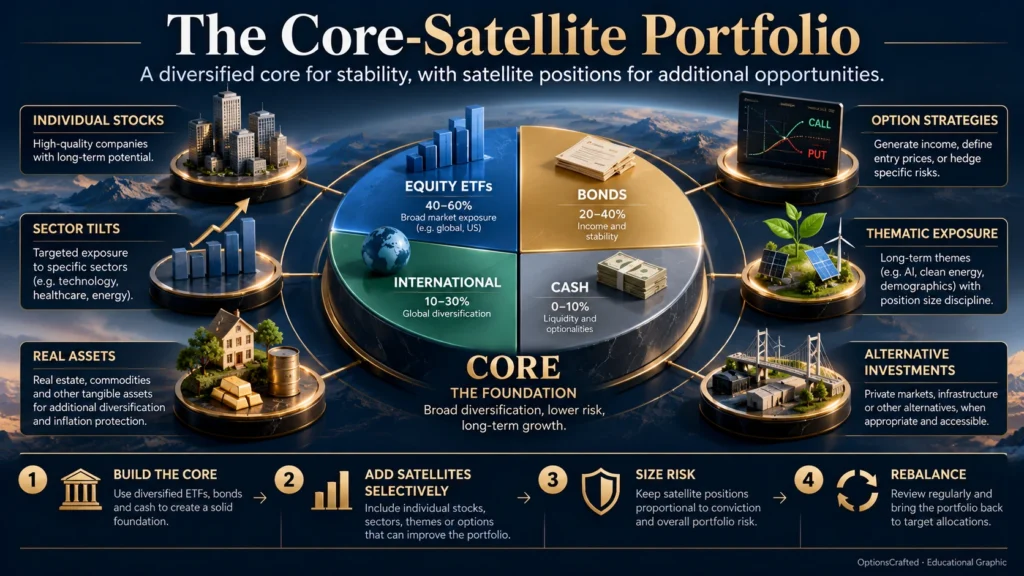
A core-satellite portfolio combines diversified market exposure with selected active positions.
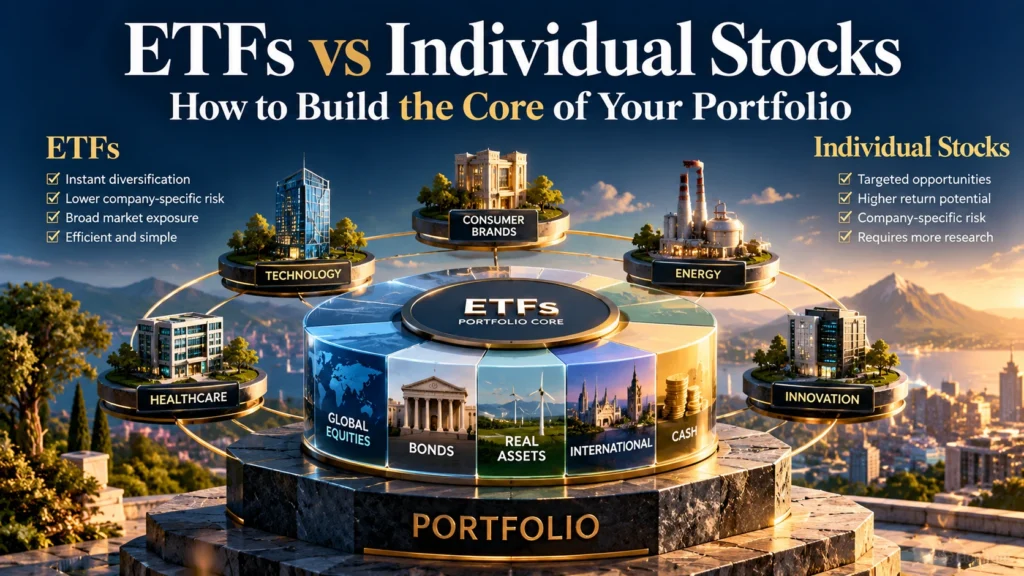
The core usually consists of broad, diversified, low-cost funds designed to provide long-term exposure to major asset classes.
The satellites are smaller positions used to express specific investment views.
These may include:
- individual stocks;
- sector exposures;
- factor tilts;
- international opportunities;
- real assets;
- digital assets;
- or option strategies.
This structure allows the investor to pursue active opportunities without making the entire portfolio dependent on the success of individual security selection.
12. How Large Should the Core Be?
There is no universal percentage that should be allocated to the portfolio core.
An investor with little interest in analyzing individual companies might rationally use a portfolio that is almost entirely composed of diversified funds.
An experienced investor with a strong research process may choose a larger allocation to individual securities.
The correct balance depends on:
- investment knowledge;
- available research time;
- tolerance for tracking error;
- portfolio size;
- tax considerations;
- risk capacity;
- and confidence in the active process.
The active portion should not become larger simply because recent stock picks have performed well.
13. When ETFs Usually Make More Sense
ETFs are often particularly useful when the investor:
- wants broad market exposure;
- has limited time for company-specific research;
- wants to minimize single-company risk;
- is building the core of a long-term portfolio;
- wants exposure to a market that is difficult to analyze security by security;
- or does not believe active stock selection will add enough value to justify the additional effort and risk.
A broad ETF can also be useful when an investor has a strong view about an asset class or region but no strong view about which individual security will outperform.
14. When Individual Stocks May Make More Sense
Individual stocks may be appropriate when the investor:
- understands how to analyze businesses and financial statements;
- has a clear valuation framework;
- is willing to monitor the investment thesis;
- wants greater control over portfolio exposures;
- has identified a specific opportunity not adequately represented in a broad fund;
- or wants to exclude businesses that do not meet defined quality or valuation standards.
The ability to buy individual stocks should not be confused with an obligation to do so.
Sometimes the most rational active decision is deciding that a diversified ETF is sufficient.
15. How ETFs and Individual Stocks Fit Into Asset Allocation
The decision between ETFs and individual stocks comes after the broader asset allocation decision.
First decide how much capital should be exposed to equities, bonds, cash, and other assets. Then decide which instruments should implement those exposures.
Our Asset Allocation guide explains why portfolio structure should come before individual security selection.
This distinction prevents a common mistake: allowing a collection of attractive stock ideas to determine the portfolio’s overall risk profile by accident.
16. ETFs and Individual Stocks for New Investors
New investors often feel that selecting individual stocks is what “real investing” means.
It does not.
A diversified ETF portfolio can be an entirely rational long-term investment strategy. It can also provide a stable foundation from which an investor gradually learns valuation, accounting, portfolio construction, and security analysis.
An investor can then add individual positions selectively rather than attempting to build an entire stock portfolio before developing the necessary analytical process.
For a broader foundation, see our guide on how to start investing.
17. Common Mistakes When Choosing Between ETFs and Stocks
Assuming Every ETF Is Diversified
Narrow sector and thematic ETFs can be highly concentrated despite holding multiple securities.
Owning Too Many Overlapping ETFs
Multiple funds may hold the same large companies, creating the appearance of diversification without meaningfully changing the underlying exposure.
Buying Stocks Without a Valuation Framework
Recognizing a good company is not enough. The investor also needs to evaluate whether the price offers an acceptable expected return.
Overestimating Research Capacity
A portfolio with too many individual companies can become impossible to monitor properly.
Chasing Thematic ETFs After Strong Performance
Thematic funds often attract the most capital after the underlying theme has already performed exceptionally well.
Letting Stock Picks Dominate the Portfolio
A few successful positions can grow into excessive concentrations if they are never reviewed or rebalanced.
18. The OptionsCrafted ETF vs Stock Framework
At OptionsCrafted, the decision between ETFs and individual stocks should follow a sequence rather than begin with a preference for one vehicle.
1. Define the Portfolio Exposure
Determine what economic exposure the portfolio actually needs before selecting the instrument.
2. Decide Whether Broad Exposure Is Sufficient
If broad market exposure solves the portfolio problem efficiently, an ETF may already be the appropriate tool.
3. Require a Reason to Concentrate
An individual stock should offer a sufficiently attractive combination of quality, valuation, and expected return to justify accepting additional company-specific risk.
4. Size the Position
Conviction does not eliminate uncertainty. Position size should reflect the consequences of being wrong.
5. Monitor the Thesis
ETF core positions may require relatively little maintenance. Individual stocks require ongoing monitoring of the assumptions that justified the investment.
In compact form:
Exposure → Diversification → Quality → Valuation → Position Size → Monitoring
19. ETF vs Individual Stock Checklist
Before choosing the investment vehicle, ask:
- What exposure am I trying to obtain?
- Does a broad ETF already provide that exposure efficiently?
- How concentrated is the ETF I am considering?
- What are its fees and underlying holdings?
- If I prefer an individual stock, what is my investment thesis?
- What valuation assumptions am I making?
- What could permanently impair the company?
- How much research time will the position require?
- How large should the position be if the thesis is wrong?
- How does it interact with the rest of the portfolio?
Frequently Asked Questions About ETFs vs Individual Stocks
Are ETFs safer than individual stocks?
Broad diversified ETFs generally reduce company-specific risk because they spread capital across multiple securities. They still remain exposed to market risk, sector risk, valuation risk, and the risks of the underlying assets.
Can ETFs outperform individual stocks?
An ETF can outperform many individual stocks while underperforming the strongest companies in its portfolio. Diversification reduces dependence on identifying the individual winners in advance.
Is it better to invest only in ETFs?
For many investors, an ETF-only portfolio can be a rational and efficient solution. Investors with sufficient knowledge and a disciplined valuation process may choose to add selected individual stocks.
How many individual stocks should an investor own?
There is no universal number. The appropriate number depends on position sizing, diversification, portfolio size, research capacity, and the degree of company-specific risk the investor is willing to accept.
Can you use ETFs and individual stocks together?
Yes. A core-satellite portfolio uses diversified funds as the foundation and selected individual stocks or other active exposures as smaller satellite positions.
Do ETFs eliminate the need for research?
No. Investors still need to understand an ETF’s objective, holdings, concentration, fees, liquidity, and role within the overall portfolio.
Final Thoughts
The debate over ETFs vs individual stocks is often framed as though investors must choose one philosophy and reject the other.
That is unnecessarily restrictive.
ETFs are powerful tools for building diversified portfolio exposure efficiently. Individual stocks provide greater control and the possibility of exploiting specific opportunities when the investor has a sound research and valuation process.
The vehicle should follow the portfolio objective.
Build the core first. Diversify deliberately. Require a reason to concentrate. Pay attention to valuation. Size active positions so that individual mistakes remain survivable.
The strongest portfolio is not the one with the most ETFs or the most impressive collection of stock ideas. It is the one in which every holding has a defined role.